Animal Testing Horror: 20 Screws Driven Into a Monkey’s Skull
For illustrative purposes only.

Update (September 1, 2026): Victory! The University of Minnesota has confirmed that experimenter Geoff Ghose “no longer works with nonhuman primates.” This development comes after PETA exposed Ghose’s incompetence and negligence as he carried out experiments in which monkeys’ scalps were cut into and metal headposts bolted to their heads. We also met with local law enforcement officials and presented evidence of apparent animal welfare violations in his lab. Please take action below to demand that the school permanently bar Jan Zimmermann and Matt Johnson from experimenting on monkeys.
Experimenters tried to conceal devastating surgical mistakes at the University of Minnesota. Take action to help monkeys!
Everett, a monkey caged in a University of Minnesota laboratory, was in severe pain.
According to reports obtained by PETA, there were numerous red flags. The rhesus macaque was lethargic. One arm was weak, a possible sign of stroke. His hair was thinning rapidly. He vomited. His eyes moved abnormally. He shook his head violently. In a clear sign of a crushing headache, he pressed his head against the bars of his cage again and again, seeking relief.
Roughly 20 metal screws drilled into Everett’s skull sank so deeply they pierced his brain, the result of a botched surgery performed by neuroscience professor Jan Zimmermann, who is not a surgeon. Documents reveal he took extraordinary steps for months to conceal what he had done while Everett suffered. The university still allows him to experiment on animals.
Documents obtained by PETA reveal disturbing treatment of monkeys by Zimmermann and fellow neuroscience professors Geoff Ghose and Matt Johnson. PETA is urging the university to permanently bar Ghose, Zimmermann, and Johnson from experimenting on monkeys and to shift resources away from experiments on animals and toward state-of-the-art, human-relevant research methods.
In one experiment, Geoff Ghose blocked infant monkeys’ vision, alternating between the left and right eyes, to induce abnormal eye alignment. He then subjected them to invasive craniotomies and neurological testing.

Covering His Tracks
PETA learned that Everett endured weeks of agony caused by 20 screws in his brain because Zimmermann prevented others from discovering the cause of the monkey’s condition and that of another monkey he operated on.
According to the reports, Zimmermann deleted a scan of that second monkey, who reportedly also showed screws protruding into the brain. It was later discovered that he also deleted notes made by a laboratory employee about Everett’s condition, including, “I’m getting pretty worried about him, and what the hell may be going on.”
Zimmermann reportedly refused to allow a veterinarian and another experimenter to review Everett’s results, then flat-out lied by telling colleagues that he had shared them and that the veterinarian found no neurological problems.
Reportedly, only when a veterinarian threatened to report him to the university’s animal experimentation oversight committee did Zimmermann disclose Everett’s condition. Everett was eventually killed.
Cutting Skulls Open
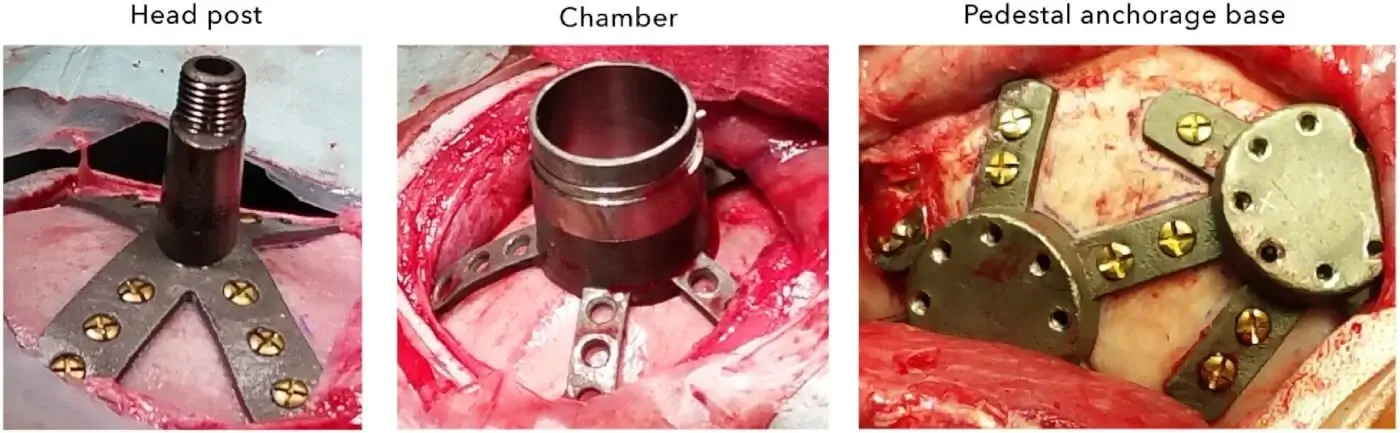 Chen X., Possel J.K., Wacongne C., van Ham A.F., Klink P.C., Roelfsema P.R. 3D printing and modelling of customized implants and surgical guides for non-human primates. J. Neurosci. Methods. 2017; 286:38-55 | CC BY-NC-ND 4.0 Deed | Attribution-NonCommercial-NoDerivs 4.0 International | Creative Commons
Experimenters cut an incision into a monkey’s scalp, remove part of the skull, and affix a headpost and cranial recording chamber to the skull. These procedures can cause significant pain and risk of infection, as well as long-term distress associated with repeated invasive access to the brain. For illustrative purposes only.
Zimmermann, Ghose, and Johnson conduct curiosity-driven experiments—funded largely by the federal government—that subject monkeys to craniotomy surgeries. They slice open a monkey’s scalp, remove part of the skull, affix headposts and cranial recording chambers to the skull, and implant electrodes and other hardware directly into the brain.
Researchers can then access and penetrate the monkey’s brain for months or years while the animals are restrained and forced to stare at screens, press levers, make gambling-style decisions, or perform visual tasks in exchange for drops of liquid.
Infection is a constant risk, since metal and ceramic hardware are not a natural part of a monkey’s head. Infections are reportedly unusually frequent in University of Minnesota laboratories. They can degrade skin and bone, weaken headpost stability, and cause posts to loosen, shift, or detach. That often means more surgery and more suffering.
Ripped From His Skull
That appears to have happened to Ponyo, a monkey in Johnson’s laboratory, who reportedly suffered from a known infection for weeks, with blood leaking from one of her screw holes. While Ponyo’s headpost was being affixed to the hardware of a restraint chair, the device reportedly detached from her skull, presumably because the infection had weakened the underlying bone.
Gandalf, a monkey in Ghose’s laboratory, reportedly had his headpost sheared off during a cage transfer, ripping the device from his skull. Reportedly, Ghose may have improperly implanted it during surgery the year before. Infection may also have contributed.
Gandalf endured the initial trauma and two additional surgeries, one to close the wound and another to attach a new headpost.
Bilbo’s Painful Ordeal
Ghose also implanted a chamber onto the skull of a rhesus macaque named Bilbo. But he placed it incorrectly. He performed a second surgery to correct the first and accidentally punctured Bilbo’s brain, causing the monkey’s heart rate and blood pressure to spike. This fiasco only got worse.
During the procedure, Bilbo’s head slipped from the device meant to hold it in place, and a metal bar jammed into his eye. The injury was so severe that he kept the eye closed for at least 40 hours.
Bilbo later underwent another surgery to remove his headpost, which was held in place by only a few screws because of infection. Ghose was urged to remove Bilbo’s recording chamber as well. He did not. The chamber later fell off, exposing Bilbo’s brain.
Surgery should have been immediate, or nearly so. Instead, the primary veterinarian, Dr. Nate Koewler, said he “wanted to think.” Three days passed before surgery occurred.
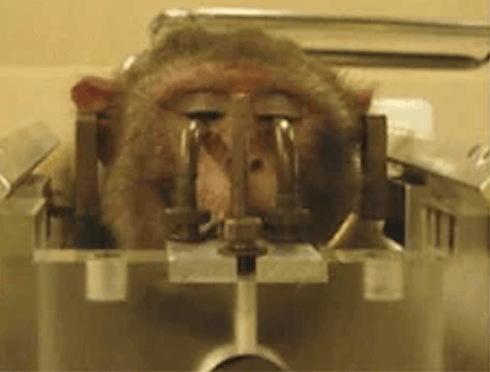
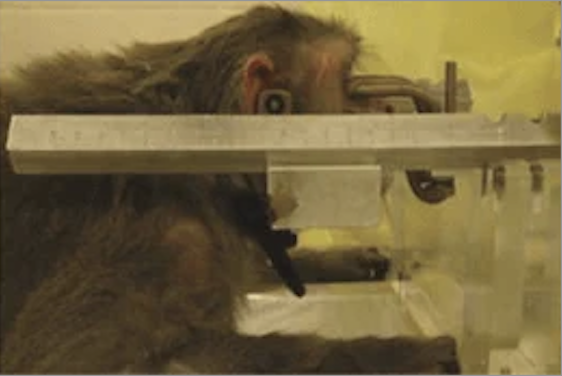
Monkeys are subjected to prolonged restraint in stereotaxic frames that immobilize their heads for invasive brain experiments, despite serious ethical and scientific concerns. For illustrative purposes only.
Slaps on the Wrist
IIn 2023, the university temporarily halted Ghose’s monkey experiments. More recently, he was stripped of the privilege to run his own laboratory after PETA shared concerns with law enforcement authorities in Minneapolis–St. Paul. He also received a reprimand letter from the university, but he has not been permanently barred from using animals. Zimmermann and Johnson also retain their surgical privileges.
Public Money for Private Profit
PETA has found that Zimmermann has a side hustle, selling his monkey-head-mangling skills to NeuralThread, a for-profit company in San Francisco. The National Institutes of Health showered the company with $1 million in tax dollars, some of which supports Zimmermann’s experiments on monkeys, and its lead experimenter previously worked at Elon Musk’s Neuralink, which has its own well-documented history of animal abuse.
Wholesale Failure
None of this cruelty occurs in a vacuum. It’s been aided or ignored by every level of oversight.
Staff raised concerns to Ghose, Zimmermann, and Johnson. They were ignored or disparaged. Then they went above the experimenters’ heads, but the animal experimentation oversight committee brushed aside their ethical concerns, suggesting a bureaucratic workaround instead of reporting the experimenters to federal authorities.
The feds were alerted. Initially, the U.S. Department of Agriculture (USDA) was also indifferent. A detailed complaint was submitted to the National Institutes of Health, including documentation of each problematic surgery, the experimenter, the monkey, and the dates. It was glossed over by the office charged with ensuring federally funded animal experiments comply with welfare standards.
Only after one inspector reviewed the situation did the USDA issue a damning report against the university.
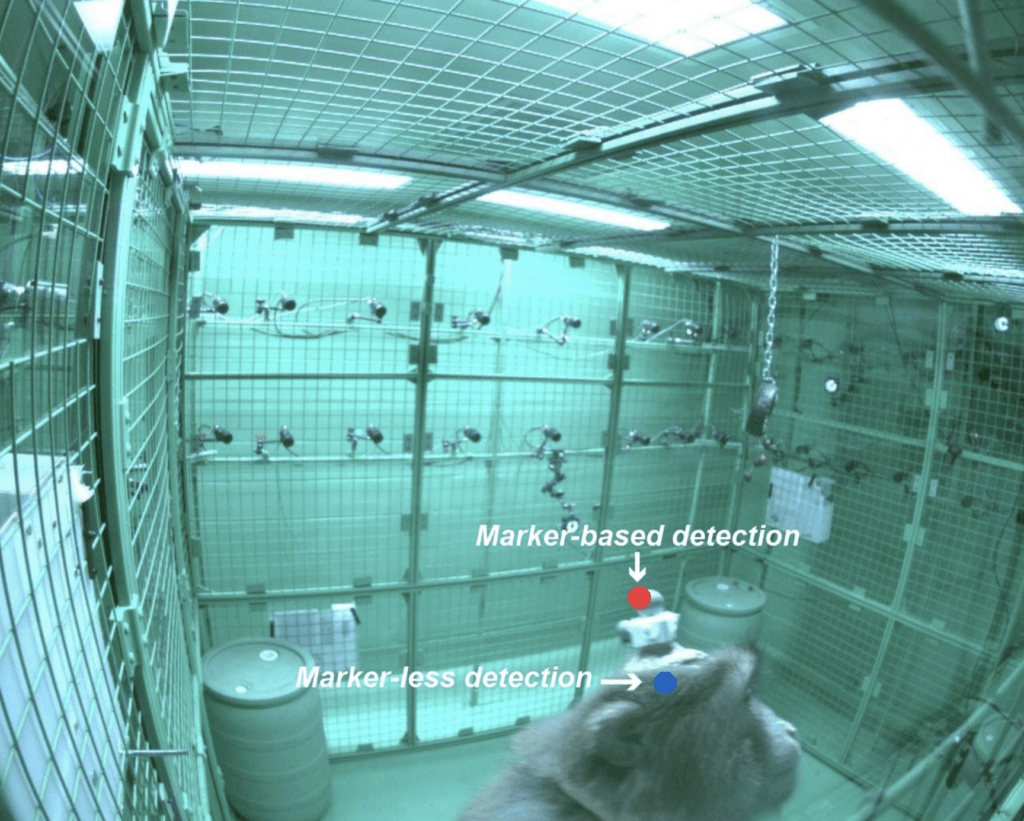
In Zimmerman’s laboratory, a monkey with a surgically implanted headpost sits inside an experimental cage while a holder with reflective markers attached to the implant tracks the animal’s head position. These procedures can cause pain, infection risk, and chronic psychological stress.
Get Involved
Please urge NeuralThread to cut ties with Zimmerman. You can do so by sending a polite email to the company’s co-founder at the address below.
Mattias Karlsson
Co-founder, NeuralThread
mattias@spikegadgets.com
PETA is calling for an immediate end to Jan Zimmermann’s and Matt Johnson’s experiments on animals at the University of Minnesota, for NIH to stop funding them, and has filed a veterinary complaint with the Minnesota Board of Veterinary Medicine. Please join us by taking action below to demand a permanent end to these experiments.
After you take action, you’ll see an easy way to share this information. Please ask five friends or relatives to support this campaign!