Whistleblower Exposé: Video of Monkeys Living in Squalor at New Iberia Research Center
PETA has received never-before-seen whistleblower footage from inside the largest primate testing facility in the United States, which confines more than 12,000 primates, appearing to show that many are kept in feces-stained squalor before they’re killed in invasive experiments.
The footage was recently taken inside the University of Louisiana at Lafayette’s New Iberia Research Center, where rhesus macaques, long-tailed macaques, pig-tailed macaques, and African green monkeys are bred onsite, bought from other facilities, or imported, and used or sold for experimentation.

Monkeys Trapped in Filth
Footage shared with PETA shows long-tailed macaques, rhesus macaques, and African green monkeys housed alone in cages barely larger than them or kept in barren, filthy cells. Many macaques are confined to small metal cages inside closet-sized rooms, where urine, feces, and rotting food collect beneath them. The animals can’t engage in basic behaviors natural to them and suffer extensive hair loss, indicating severe chronic stress.
The video shows a force-breeding setup: Cages are opened to give male rhesus macaques access to trapped females. There is no choice, no escape. One female shows clear signs of injury—large areas of missing hair and wounds on her head. Elsewhere in the facility, African green monkeys are held in barren breeding cages, the floors smeared with layers of feces.
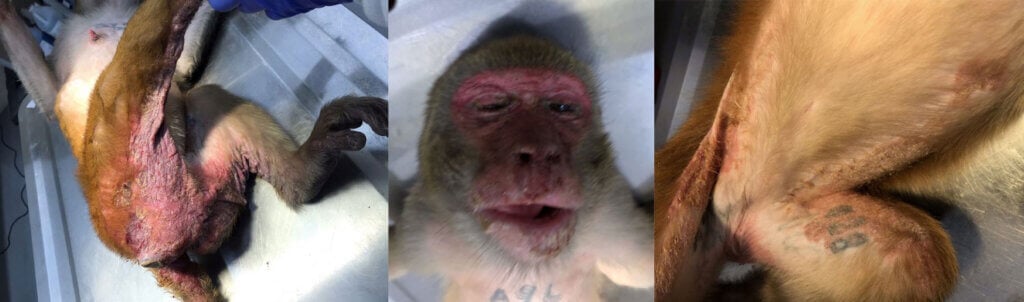
A rhesus macaque at NIRC known as “Helen” suffered from chronic, severe skin irritation for years that was never resolved. Eventually it became so severe that staff had to euthanize her.
Credit: Photo obtained by Rise for Animals through a public records request.
Beyond the Images: Decades of Invasive Experiments at New Iberia Research Center
While the whistleblower footage reveals how monkeys are confined day to day, it captures only the settings—not the full scope of what is done to animals inside this facility.
U.S. taxpayers foot the bill for staff at the center to subject monkeys to numerous pointless experiments. Many are infected with viruses, including respiratory syncytial virus (RSV) or simian immunodeficiency virus (SIV), and endure a traumatic cycle of repeated anesthesia, blood draws, and invasive procedures.
Experimenters inject the viruses into the animals’ rectums or vaginas and stuff tubes down their throats. Many then endure excruciating rectal, vaginal, and cervical biopsies, as experimenters remove pieces of tissue from some of the most sensitive parts of their bodies.
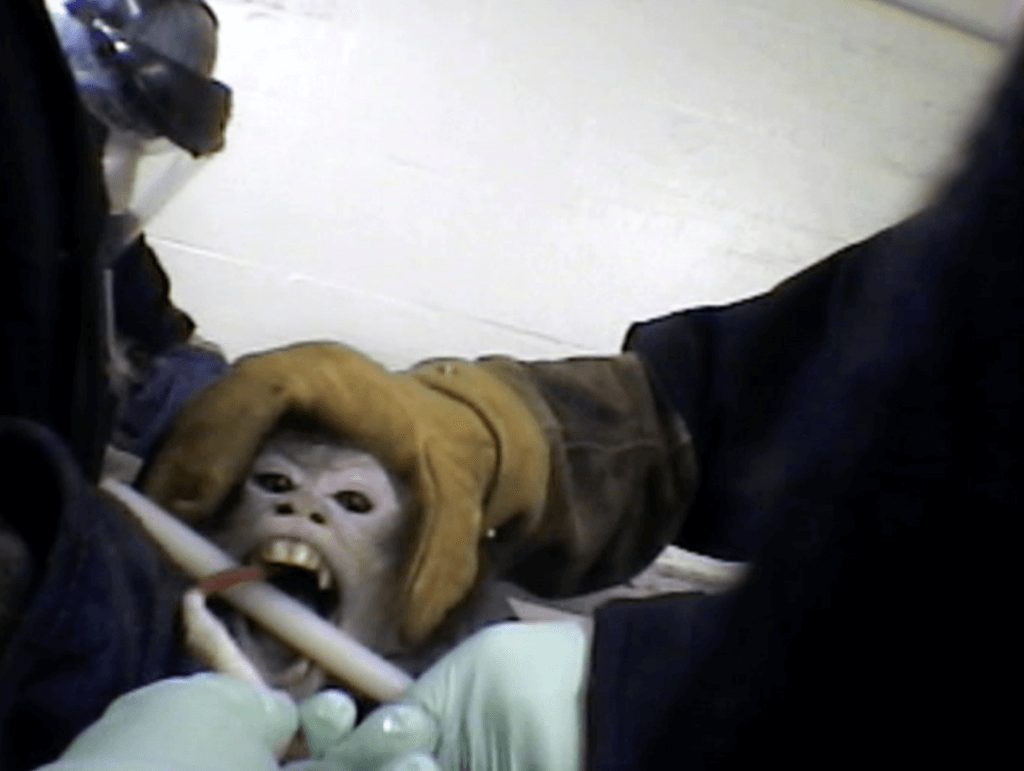
Experimenters stuff tubes down monkeys’ throats or noses to force them to ingest substances. For illustrative purposes.
In one test, experimenters flush fluid into the animals’ lungs, then suction it back out. Other experiments involve injecting animals with radioactive substances. Experimenters then kill and dissect the monkeys.
Violating the Rules, Again and Again
The New Iberia Research Center has a documented history of animal deaths and violations of the federal Animal Welfare Act. Animals die preventable deaths due to inadequate care, poor facility maintenance, and no oversight, records show. This hellhole was recently cited by the U.S. Department of Agriculture (USDA) for letting 19 monkeys die after staff left them outside for days with nothing but plastic barrels for protection in temperatures as low as 2 degrees. Necropsies showed that 13 of the monkeys were suffering from underlying conditions before they were left in the cold.
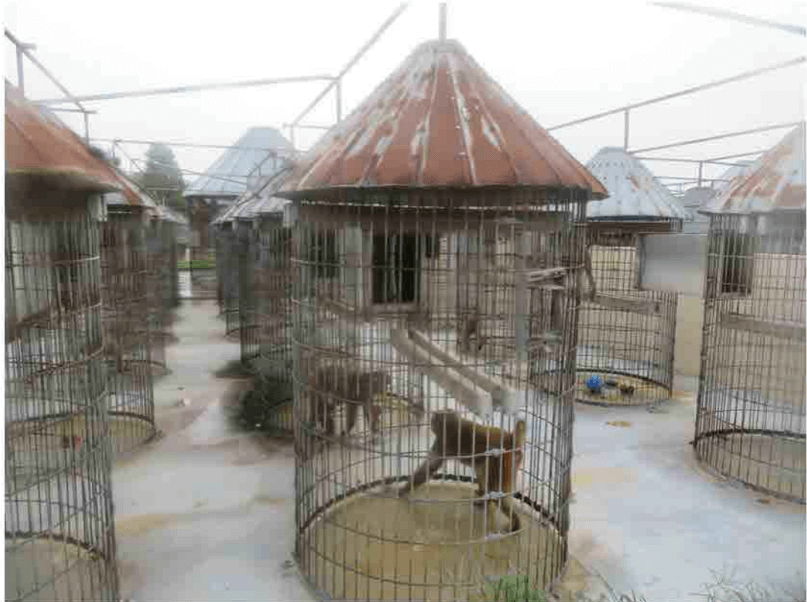
Rhesus macaques at New Iberia Research Center are housed in desolate cages with improper shelter from the elements. Obtained through FOIA by PETA
Infant monkeys died of dehydration after a water system failed. Other animals were electrocuted to death by faulty infrastructure or killed by heat exposure and freezing temperatures. Improper handling has injured more, while monkeys repeatedly escaped from broken, poorly maintained enclosures.
According to another whistleblower, these failures are not isolated accidents, but the predictable result of deliberate cost-cutting by leadership at the center. Staff are expected to keep aging systems running with improvised fixes, rather than being provided with properly functioning equipment. This pattern has repeatedly led to animal deaths during extreme heat and cold.

A 5-year-old male rhesus macaque—known only as “A13X040″—escaped from the facility and fled into nearby woods. Two days after experimenters noticed the escape, the macaque was found on a roadway and brought back to his prison.
Necropsy reports reveal disturbing cases of infant monkeys dying and being found with their remains mutilated by other stressed monkeys. In some instances, their bodies had decomposed so much before staff retrieved them that they couldn’t determine the cause of death. Other reports show adult monkeys dying excruciating deaths, including one who died from a long history of injuring himself, a frequent issue in laboratories where these social animals are confined alone in tiny, barren cages. Records show that after tests suggested bone cancer, another monkey remained on a study for months as a tumor progressively grew, until her health deteriorated so much that she had to be euthanized.
USDA inspection reports document the center’s culture of careless disregard, showing that monkey escapes, deaths, and improper veterinary care are business as usual. The agency has fined the laboratory more than $158,000 in penalties since 2007.
What You Can Do
PETA is urging the USDA to investigate the apparent Animal Welfare Act violations depicted in the footage captured by the whistleblower, and urging the National Institutes of Health not to renew grants or contracts with the center.
You can help by taking action to urge the National Institutes of Health to stop funneling millions of dollars into this shameful monkey laboratory.